
Hearing Loop Systems
A hearing loop system sends sound by a magnetic field to hearing aids with a T-coil setting, so speech is heard clearly over background noise. This page holds counter and room loop amplifiers and kits, portable loops, loop cable and copper foil tape, receivers and test equipment, mainly from Opus Technologies and C-TEC.
 Save £1.88
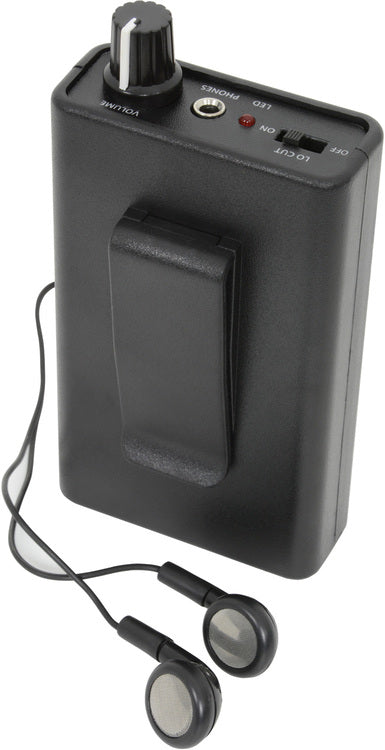
Adastra: 952.855UK, Induction Loop Receiver, Battery Powered, 3.5mm Jack, Lightweight, 80g
Compact Design£ 20 78RRP: £22.66Fast delivery Tomorrow, 20 Nov

C-TEC APXM pin microphone plate
£ 52 96

 £ 22 23

C-TEC ML1 counter hearing loop
£ 131 38


C-TEC APT loop connector plate
£ 48 30

Signet ABT-CU-11LCD control unit
£ 2,505 14 £ 80 19


Signet AKH1/L induction loop kit, Wall Mount
£ 1,169 78


C-TEC DL50/K loop amplifier kit
£ 235 88


Choosing Hearing Loop Systems
Size the amplifier to the room, then add the microphones, inputs and loop cable the installation needs.
Room amplifiers
The C-TEC PDA200E is a wall-mounting amplifier in a metal enclosure for permanent installation, for spaces up to 200m². The table gives the room that five Opus LD amplifiers cover with a single loop, and the LD3.2 covers 2,000 m² in a single loop or 1,000 m² in multiple loops.
| Opus model | Room covered with a single loop |
|---|---|
| LD1.0LITE | 180 m² |
| LD1.0 | 250 m² |
| LD2.0 | 450 m² |
| LD3.0 | 900 m² |
| LD4.2 | 3,300 m² |
Kits for a room
The C-TEC AKL1 lecture room kit pairs the PDA200E with an AMT tie/desk microphone, an AML lectern microphone and two APJ input plates. The AKR1 waiting room kit pairs the PDA200E with an APL line level audio input plate for connecting to a paging system, and the AKT1 suits a TV or music lounge. The AKL1 does not include the loop cable. For homes, the C-TEC DL50/K is a free-standing domestic kit for 50m², with an alert tone input for doorbells, fire alarms and security systems.
Counter and portable loops
The C-TEC ML1/K counter loop kit gives a listening field of about 1.2m² from a double-gang amplifier and a pre-formed counter loop, for post offices, banks, ticket offices and reception areas. The Opus DCL20-65 sits discreetly within a counter or desk and includes a DCL20 amplifier, an external power supply and a 1.80m loop cable. The C-TEC PL1/K3 is portable, with one-button operation and an integral microphone.
Loop cable and foil
The C-TEC LOOP2/W is a 100m reel of white 1.0mm² single core cable for a floor or ceiling loop, with 1.5mm² in the LOOP3/W and 2.5mm² in the LOOP4/W. The FLAT2005 is a 100m reel of 1.0mm² insulated flat copper foil tape for a floor loop under light duty carpets.
Testing and listening
The C-TEC FPROK1 test kit simplifies setup to BS EN 60118-4. The Adastra LR2 receiver comes with in-ear and over-ear headphones for audio tours in art galleries and museums.
Related categories
See other accessibility products in disabled refuge and toilet alarms, refuge call equipment in EVC and refuge call, and PA amplifiers in 100V audio amplifiers. See also Nurse Call Systems.
Brands we stock in Hearing Loop Systems
Adastra, C-TEC, CIE Group, Opus Technologies, Signet and Videx.
Frequently asked questions
Do NHS hearing aids work with a hearing loop?
Yes, many NHS hearing aids have a telecoil, often called the T setting, which picks up the sound from a hearing loop. If the T setting has not been switched on, the audiologist can usually enable it. The loop then carries speech straight to the aid, cutting out much of the background noise. The range here includes room, counter and portable hearing loop systems.
What is a hearing loop system?
A hearing loop system, also called an induction loop, is an assistive listening system that helps hearing aid users hear speech clearly in public spaces and homes. It is common at counters, reception desks, meeting rooms, lecture rooms and places of worship. Look for a system that meets BS EN 60118-4 when correctly installed. The range here includes amplifiers, loop kits, receivers and test meters.
How does a hearing loop system work?
An amplifier takes sound from a microphone or audio source and drives a current through a loop of cable laid around the room, which creates a magnetic field. A hearing aid switched to its telecoil picks up that field and turns it back into sound, so the listener hears the speaker directly. Metal in the building can weaken the field, so some amplifiers have metal compensation.
Why buy from West Midlands Electrics
- Established 1975
- Birmingham trade counter
- UK-only supply
Updated
You may also like
-
Save £1.88
Adastra: 952.855UK, Induction Loop Receiver, Battery Powered, 3.5mm Jack, Lightweight, 80g
Compact Design£ 20 78RRP: £22.66Fast delivery Tomorrow, 20 Nov -
-
C-TEC APXM pin microphone plate
£ 52 96 -
-
-
£ 22 23
-
C-TEC ML1 counter hearing loop
£ 131 38 -
-
-
-
C-TEC APT loop connector plate
£ 48 30 -
-
Signet ABT-CU-11LCD control unit
£ 2,505 14 -
£ 80 19
-
-
-
-
-
Signet AKH1/L induction loop kit, Wall Mount
£ 1,169 78 -
-
-
-
-
-
-
C-TEC DL50/K loop amplifier kit
£ 235 88